Tradition and Timekeeping: On Ancient Egyptian Horology
Giorgina Paiella
The tradition of timekeeping begins in Ancient Egypt. An understanding of the passing of time was shaped by a connection to the natural world and careful tracking of its cycles.
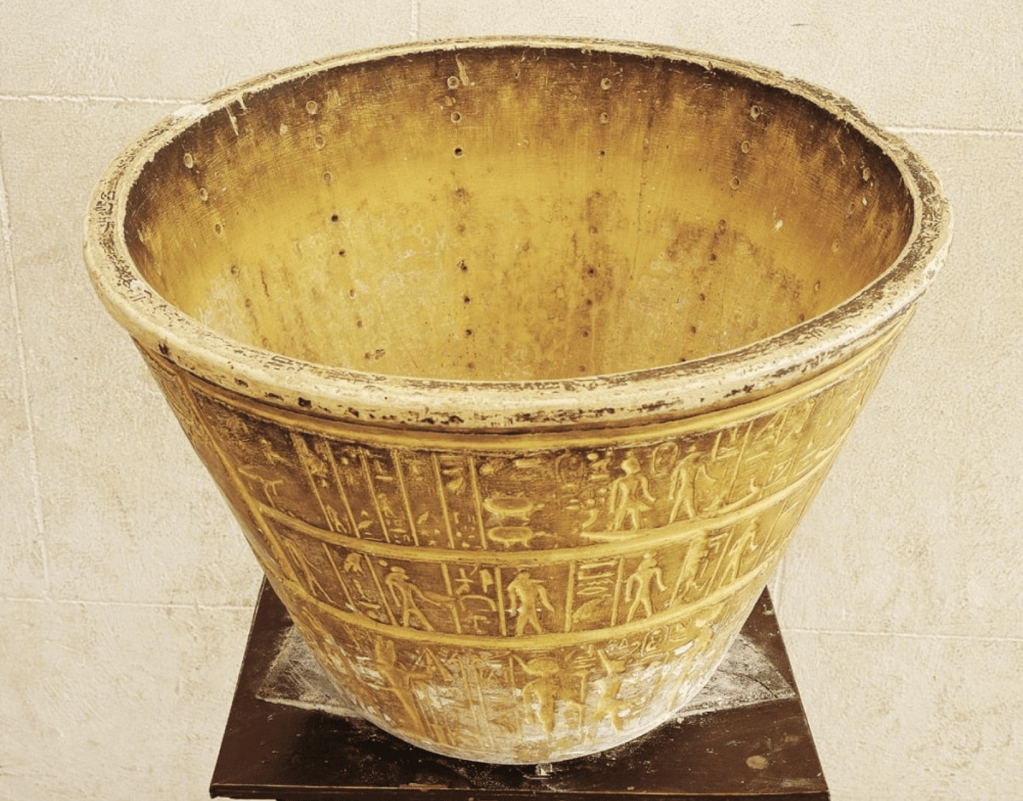
The Ancient Egyptians were the first civilization to divide the day into parts, and the first to create sophisticated timekeeping devices that measured the natural environment: clocks, sundials, and merkhets. The oldest documented water clock is detailed in a tomb inscription of inventor Amenemhet in the 16th century BC, and the oldest water clock existing in physical form, circa 1417 – 1379 BC, dates to the reign of Amenhotep III, ninth pharaoh of the 18th dynasty. These stone vessels were inscribed with twelve columns that marked the passing of the hours through the passage of water, signaling the time of day once the water had reached each column.
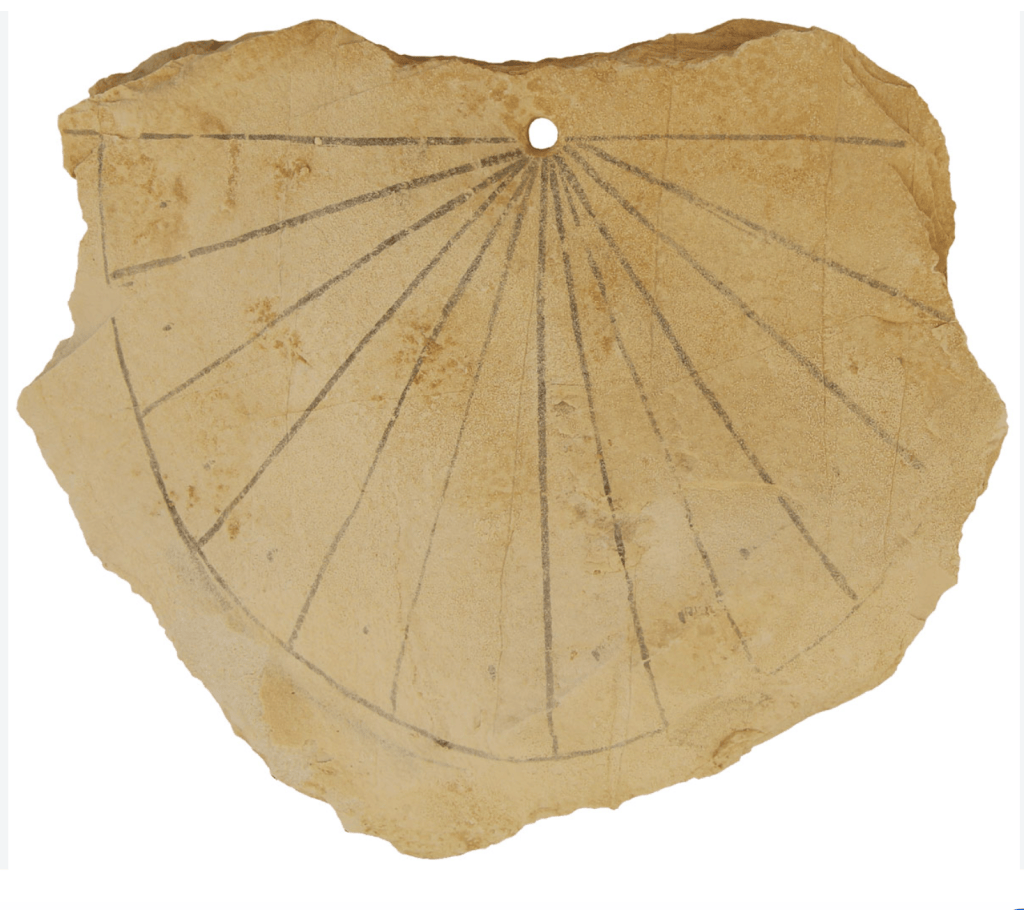
The oldest known sundial dating back to 1500 BC was used to measure daylight hours based upon the position of the sun in the sky and its shadow cast on the device.
The merkhet, merjet (mrḫt in Ancient Egyptian), or “instrument of knowing,” was used for land surveying and timekeeping. The device tracked the position of the stars: ten stars for ten hours of night, with one hour dedicated to sunrise and another to sunset.
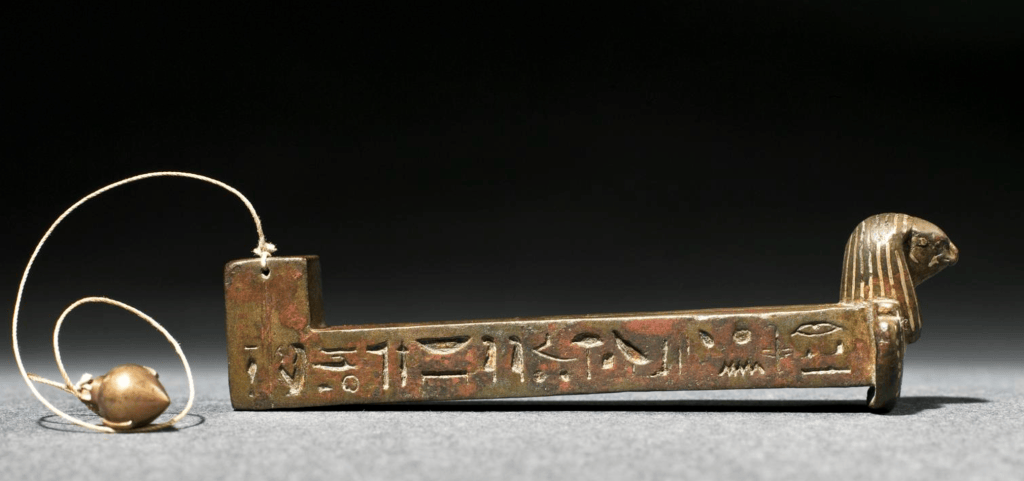
Each device had its specialized purpose and value. The sundial was only useful during day, and the merkhet only at night.
The first solar calendar was also created in Ancient Egypt, tracking the earth’s revolutions around the sun. The solar calendar outlined a 365-day year, divided into three seasons of 120 days each, and an intermediary month of five days to align with the seasons. The origins of this calendar are traced to the earliest days of Ancient Egyptian civilization and reflect the centrality and importance of the sun, revered for the gift of warmth, vitality, and creation, symbolized by Ra, the sun deity considered creator of all forms of life.
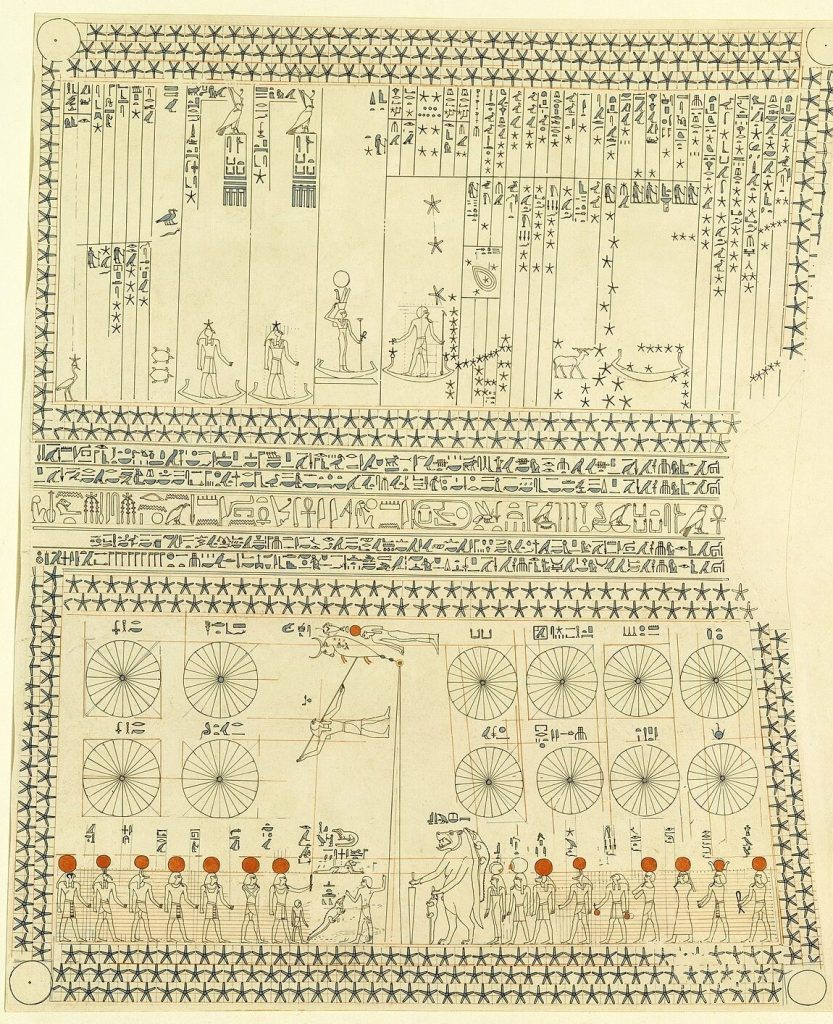
Tablet records reveal that by around 3,000 BC, the first dynasty of Egypt, Ancient Egyptian civilization had already linked the rise of Sirius, the brightest star—known as Soptdet, or Sdpt, in Ancient Egyptian, meaning “triangle”—to the start of the year.
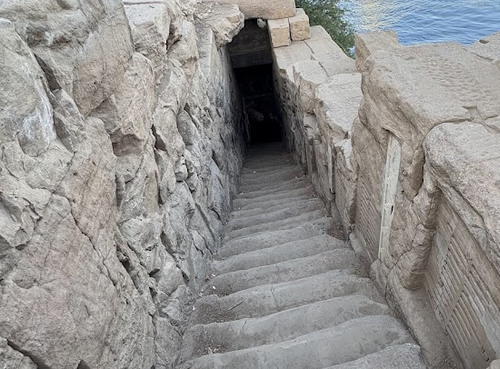
Also as early as 3,000 BC, during the reign of Pharaoh Djer, the Ancient Egyptians were regularly keeping records of the levels of the Nile River and its cyclical flooding. A structure called a Nilometer was created to track these cycles, and detailed records were kept that structured life around the natural environment. Nilometers took many forms, ranging from a vertical column submerged into the river with marked increments to measure water levels, to stairs descending into the water with labeled interval measurements, to canals that led from the bank of the river into a cistern.
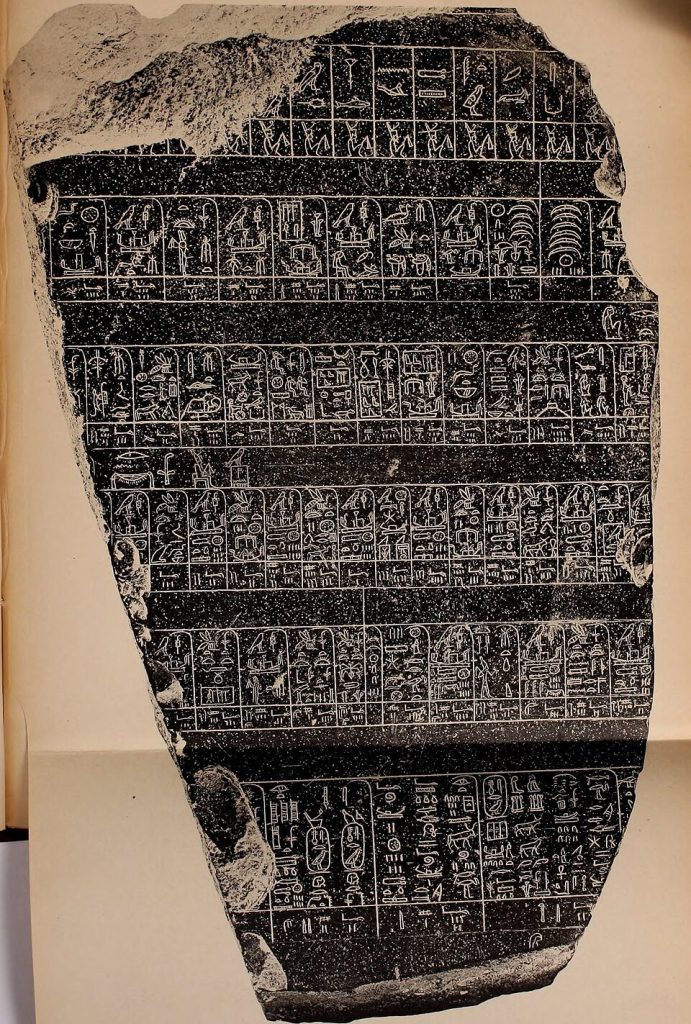
The Nile flood levels were documented yearly in the royal annals, stone tablet records of yearly events. In addition to flood levels, the stone archives detailed yearly events, ceremonies, ruling pharaohs, tax collections, and other administrative record-keeping.
The Nile was vital to Ancient Egyptian culture and civilization, a literal and metaphorical source of life. The river was so essential to the identity of Ancient Egypt and its civilization that Egypt itself was named Kemet (km.t), meaning “the black land,” referring to the fertile, rich soil of the Nile flood plains. The Ancient Egyptians understood that the key to a thriving culture and civilization was a deep reverence and respect for nature as a source of life. An understanding of the cycles of the Nile—its yearly flooding and low water periods—was a way to reap the gifts of the natural world and to situate human life in the context of its cycles. High water, flood, low water. Birth, death, afterlife. Everything is cyclical: each phase passes, gives rise to, and transforms into another.
The Nile was powerful, and the human relationship to it delicate and dependent. There was a keen awareness of the importance of the yearly flood and the interdependence of human life, crops, and the environment. Too little or too much flooding was disastrous, causing either famine or destruction of infrastructure, respectively. These cycles dictated every aspect of existence, and were memorialized in poetry. In “The Hymn to the Nile,” verses praise the beauty of the flood:
The night remains silent, but all is changed by the inundation; it is a healing-balm for all mankind.
Establisher of justice! Mankind desires you, supplicating you to answer their prayers;
You answer them by the inundation!
And, because the floodwaters served as a source of nourishment, the consequences if the flood is not substantial enough:
all that is produced is of the choicest;
all the plants exist for your children.
If you have refused [to grant] nourishment, the dwelling is silent, devoid of all that is good, the country falls exhausted.
The hymn ends with an exaltation for prosperity:
Come (and) prosper, come,
O Nile, come (and) prosper!
The centrality of Nile flood cycles led the civilization to divide the year into three agriculturally-based seasons based on the flooding cycles of the Nile: Inundation, Emergence, and Harvest.
Akhet (ꜣḫt), Inundation (September to January). This is the first season of the year, referring to the annual flooding of the Nile. The season is divided into four months of flood.
Peret (Prt), Emergence (January to May). The second season of the year refers to the emergence of fertile soil and the planting and growth of vegetation and crops post-flood, with four months therein.
Shemu (Šmw), Harvest (May to September). This is the third and final season of the year, referring to the season of the agricultural harvest. This season of low water is the dry season prior to the flood, consisting of four months.
The original Ancient Egyptian solar calendar served as the civil calendar, and later evolved into the Coptic Calendar. The Coptic calendar retains the seasonal subdivisions of the ancient calendar, consisting of three seasons, each four months long.
| Transliteration of Month Name | Julian Dates | Gregorian Dates |
| Thout | 29 August – 27 September | 11 September – 10 October |
| Paopi | 28 September – 27 October | 11 October – 9 November |
| Hathor | 28 October – 26 November | 10 November – 9 December |
| Koiak | 27 November – 26 December | 10 December – 8 January |
| Tobi | 27 December – 25 January | 9 January – 7 February |
| Meshir | 26 January – 24 February | 8 February – 9 March |
| Paremhat | 25 February – 26 March | 10 March – 8 April |
| Parmouti | 27 March – 25 April | 9 April – 8 May |
| Pashons | 26 April – 25 May | 9 May – 7 June |
| Paoni | 26 May – 24 June | 8 June – 7 July |
| Epip | 25 June – 24 July | 8 July – 6 August |
| Mesori | 25 July – 23 August | 7 August – 5 September |
| Pi Kogi Enavot | 24 August – 28 August | 6 September – 10 September |
The first year of the Coptic calendar begins in 284 AD, known as Anno Martyrum (AM), the “era of the martyrs,” marking the ascension of Emperor Diocletian to the throne, whose reign launched a wave of severe persecution and execution of Egyptian Christians, and more widely, Christians throughout the Roman Empire. The year begins on Nayrouz, the first of the month of Thout, and the first month of the year. Nayrouz derives from the Coptic ⲛⲓⲓⲁⲣⲱⲟⲩ, meaning “the rivers,” in turn originating from the Ancient Egyptian itrw, referring to the Nile river. Nayrouz is referred to as “the crown of the year” (ⲡⲓⲭⲗⲟⲙ ⲛ̀ⲧⲉ ϯⲣⲟⲙⲡⲓ), and it is the day on which all martyrs and confessors are commemorated in the Coptic Church.
Calendars and other methods of timekeeping are far from neutral, and have deep histories tied to ancient heritage and cultural shifts, in addition to delineating periods of conquest and the associated reforms of given rulers. Built into the Coptic calendar is both a fidelity to Ancient Egyptian history, and a remembrance of past persecution memorialized in the present day. In earlier times, the Ptolemaic calendar was proposed in 238 or 239 BC as part of the Canopus Decree in an attempt to remedy what was called “the wandering year” in the Ancient Egyptian calendar. The calendar was ultimately rejected by the indigenous Egyptian priesthood and general population at the time because it was a product of foreign rule, disrupting native practices of holy days and tradition, and imposed through Greek occupation.
There are also other forms of timekeeping that did not become the centralized civil calendar. While the Ancient Egyptians also developed a lunar calendar for festivals and rituals dated to around 2880 BC, the lunar calendar did not become the main civil calendar because it is not synced with the solar year, and therefore could not accurately predict the Nile flood cycles.
The Julian calendar implemented in 45 BC utilized the structure of the Ancient Egyptian calendar, with an added mandatory leap year to prevent drift. The Julian calendar was replaced by Papal Bull with the Gregorian calendar in 1582, which thereafter became the most widely used civil calendar globally. The Coptic church calendar shares the same leap-year rule as the Julian calendar, and continues to align with the tradition of the ancient calendar.
Carrying forward this legacy means continuing to honor the ancient practices informed by the seasons and the importance of tradition and ritual tied to the natural world. There are many complex questions about how to maintain a relationship to the earth and its patterns in an increasingly digital and disconnected world, but Coptic rituals—in turn based upon Ancient Egyptian practices— provide some answers.
Two tangible examples can be found in ancient festivals that continue to be celebrated in the present day, like Nayrouz and Sham el-Nessim. The liturgy of the Feast of Nayrouz includes prayers and hymns to bless the natural environment:
Bless the crown of the year with Your goodness, O Lord: the rivers, the springs, the plants and the fruits.
In tandem with the liturgy and lighting of candles, a number of traditional, symbolic foods tied to agricultural tradition are consumed on the day. The feast coincides with the harvest of fresh, red dates native only to Egypt. The red exterior of the dates symbolically represents the blood of the martyrs, the white interior their purity of heart, and the pit their unwavering faith. White-fleshed guavas are another traditional crop with similar symbolism.
Sham el-Nessim, meaning “smelling the breeze” in Arabic, derives from the Ancient Egyptian season of shemu, the low water or harvest season, and is a tradition dating back to 2700 BC. Always celebrated on Coptic Easter Monday, the holiday celebrates rebirth, resurrection, and new life. After a period of mourning and fasting during Lent, it represents the revival of life, and remains tied to ancient practices of the harvest season. Traditional foods prepared in the present day align with the seasonal harvests of ancient times, and the symbolic crops worn for protection, used in processions, and offered to the deities: termis (lupini), green onions, lettuce, and green chickpeas. (And for those who use and consume animal products, the decoration of colored eggs, and the infamous fesikh.) The day is spent outdoors taking in the air.
The ancient traditions of timekeeping exemplify how practices and methods of measuring and marking time can shape our understanding of our existence in the world. They demonstrate how human life can be situated non-hierarchically and non-destructively, at peace with nature in all its abundance and diversity, and serve as a guide for how to live a spiritual life shaped by indigenous practices that honor the earth and all living creatures.


You must be logged in to post a comment.