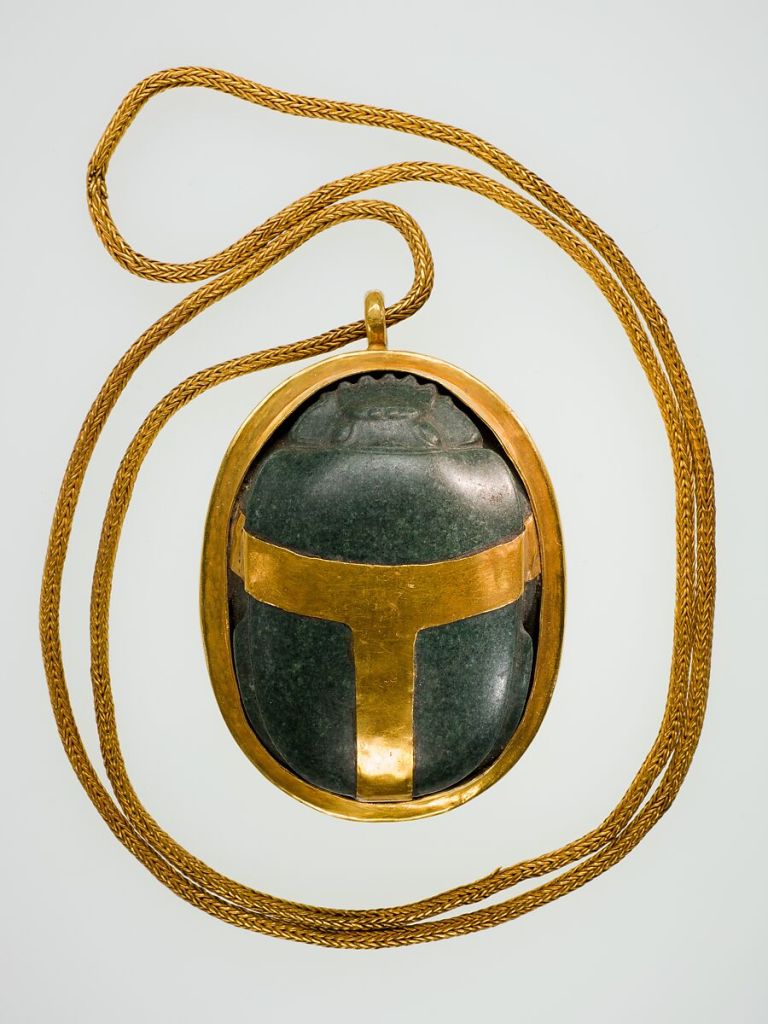
Heart Scarabs
Heart Scarabs were scarab amulet artifacts placed either on top of the heart of the deceased, or in the heart cavity itself. The heart, or ib, was the only organ of the human body left in place during mummification, as it was considered the seat of all memory, intelligence, and actions.
The heart was believed to be able to speak on behalf of the deceased. The scripts engraved upon heart scarabs were intended to entreat the heart to silence, and to appeal the heart to not bear false witness against its owner during the Weighing of the Heart judgement ceremony.
These amulets were widely used by the 11th dynasty of Egypt, and over time evolved to take on many variations in size, design, and scripts.
The most common scripts engraved upon heart scarabs were codified from Ancient Egyptian funerary papyruses and became known as The Spells of Going Forth by Day (in Ancient Egyptian, translated as, Utterances of Coming Forth in the Day). Though these texts were codified in this form during the New Kingdom, many components and texts therein existed and were in use in various forms throughout the Old, Middle, and New Kingdoms.
The most common engraving upon a heart amulet was chapter 30B from this text. The spell was believed to be originally discovered in a temple by Prince Djedefhor in the 4th Dynasty. Spell 30A was also sometimes used—though more rarely—as in the case of the Heart Scarab of Hatnefer, pictured in the first two images on this page.
Spell 30A
My heart of my mother,
my heart of my mother,
my heart of my earthly being
Do not stand against me as witness
beside the lords of the ritual
Do not say against me, "he did do it," about my actions
Do not make a case against me beside the great god
Hail my heart, Hail my heart,
Hail my entrails, Hail those gods
At the fore, tressed, resting upon their sceptres
Tell my goodness to Ra, hand me to Nehebkau
See him, uniting the earth at the great one within
May I endure on earth, not die in the west, and be a blessed spirit there
Spell 30B
O my heart of my mother!
O my heart of my mother!
 O my heart of my different forms!
Do not stand up as a witness against me,
do not be opposed to me in the tribunal,
do not be hostile to me in the presence of the
Keeper of the Balance, for you are my ka which was in my body, the protector who made my members hale.
Go forth to the happy place whereto we speed, do not make my name stink to the Entourage who make men.
Do not tell lies about me in the presence of the god.
It is indeed well that you should hear!
 Giorgina S. Paiella, Ph.D.
You must be logged in to post a comment.